


Welcome back to MktContext where we study the US economy and time the stock market.
We’ve been calling for the off-ramp from the Iran war and the oversold rebound in markets. This has occurred in spectacular fashion within the span of two weeks. The US and Iran are working on a negotiation but the prospects are grim.
Under the hood, there is huge divergence within tech stocks. Certain mega cap stocks like PLTR and TSLA (which we gave as a short idea) are breaking under key supports. Meanwhile, leaders in chips and opto-electronics are breaking to new highs.
Can markets hold this gap-up? Should you be buying here? One thing is for sure — you don’t want to be sitting in cash waiting for the dip that never comes.
Today’s topics: Temporary ceasefire, how the Iran situation resolves, macro and inflation, new portfolio changes.

Temporary ceasefire
On Tues evening, just hours before Trump’s “bomb power plants“ ultimatum was set to expire, Iran and US came to a two-week ceasefire agreement. Both sides are claiming victory, which begs the question: Who blinked?
Iran’s mosaic defense and asymmetric endurance strategy was on full display as they endured against a stronger successor. Because of it, Trump finally understood that Iran does not bend to pressure, and further escalation (hitting power and desalination plants) would not yield strategic results.
We know that last week, Iran rejected a temporary ceasefire and walked away from negotiations. They were comfortable continuing the war thanks to their “preservation” strategy and leverage over Hormuz. Something must have changed to bring them back to the table.
By Trump’s own admission (below) the US accepted Iran’s 10-point plan, as opposed to Trump’s own 15-point plan. This includes removing sanctions and allowing Iran to continue enriching uranium and continue commanding Hormuz. These are meaningful concessions that the US would be ill-advised to agree to unless truly out of options.
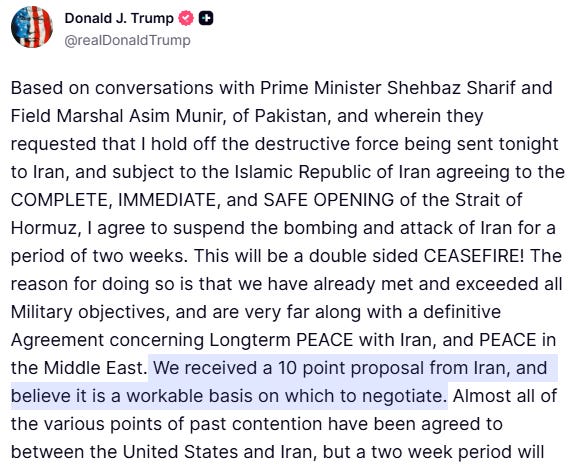
It is surprising that Trump would agree to Iran’s terms, which is why the market is highly skeptical this ceasefire will hold. Here’s why:
From the get-go, nuclear disarmament was a strategic priority for the US; allowing enrichment would legitimize Iran’s nuclear program. If the world’s largest military couldn’t stop Iran, no other country and no future US president will dare try again.
Yielding Hormuz to Iran is a huge strategic blunder as well. For one thing, they have the power to disrupt global trade. It gives them leverage over their Gulf neighbors. It also damages the global dominance of the US Dollar as Iran can stipulate trade in Chinese Yuan or Bitcoin. Not good for a US that relies on trade deficits and external debts with the rest of the world.
If Iran imposes a toll on ships passing through Hormuz, they would earn more off of other nations’ oil than they earned selling their own! They would become one of the wealthiest chokepoint operators in maritime history. And that’s before money received from unfrozen assets, restitutions, and sanctions lifting.
So the country with no navy, no air defense, no Supreme Leader, no missile production, and no nukes… managed to extract a major concession from the US. This is not an indictment of Trump or the US military — who certainly did immeasurable damage to the regime. But it appears that Trump was more eager for an off-ramp than Iran. This is crucial to understanding the ceasefire’s durability and the new world order.
To see our trades and portfolio, consider upgrading to paid subscriber status.
What happens after 2 weeks?
The rest of this article is for premium members. Upgrade now to continue reading:
What comes next
Tollbooth in effect
Oil is flowing
Global industrial reordering
Wall of worry
Fiscal and earnings
Our portfolio
Claim your free trial by clicking the button below!
